How Much Space Do You Need for a Kiddie Ride Area?
Kiddie ride space planning should include more than the machine footprint. Buyers also need to consider operating clearance, customer waiting space, access, power and circulation before choosing equipment. Small, medium and larger layouts can be used as planning examples, but the final arrangement should always be checked against the actual equipment and venue conditions.
- 1. Separate Equipment Footprint From Operating Space
- Equipment Footprint
- Operating Clearance
- Customer Waiting and Circulation Space
- 2. Plan the Area According to Project Scale
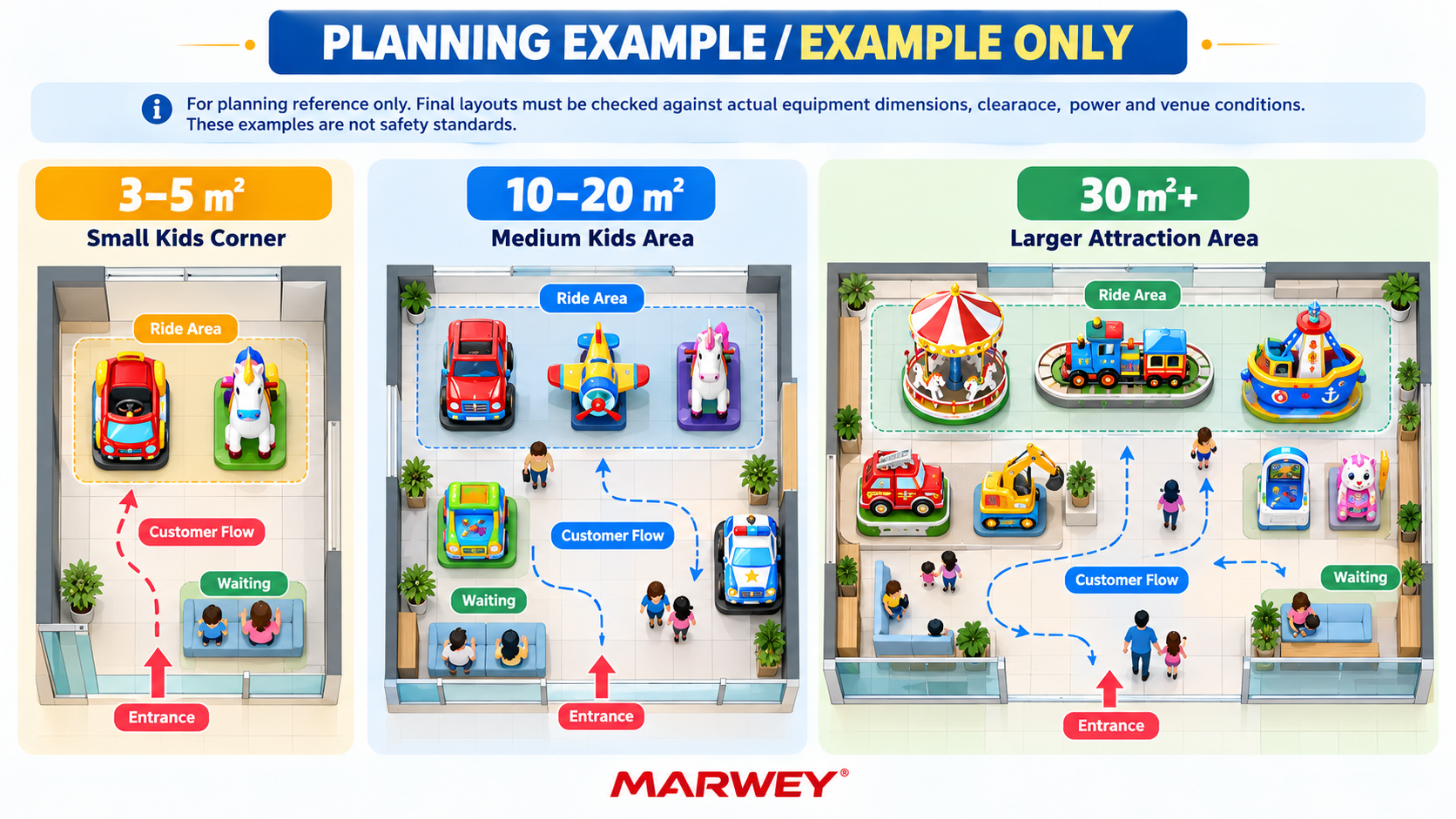
- Small Kids Corner — 3–5㎡ Planning Example
- Medium Kids Area — 10–20㎡ Planning Example
- Larger Attraction Area — 30㎡+ Planning Example
- 3. Measure the Site Before Selecting Equipment
- Length and Width
- Ceiling Height
- Door and Access Width
- Power Location
- Floor Condition
- Fire and Emergency Access
- Visibility
- 4. Why Equipment Footprint Alone Is Not Enough
- 5. Use Space Ranges as Planning Examples
- 6. Plan Customer Flow Before Finalizing the Layout
- 7. Leave Room for Future Changes
- FAQ
- How many rides fit in 10 square meters?
- Can a ride be installed near a checkout area?
- Build the Layout Around the Actual Venue
Planning a commercial kiddie ride area starts with more than measuring the footprint of a machine.
A workable layout also needs room for customer movement, operating clearance, access, power preparation and the surrounding activities of the venue. A ride may physically fit into a floor plan while still creating problems if there is not enough space for people to approach, wait or move around it.
For this reason, kiddie ride space requirements should be evaluated as part of the complete venue layout rather than as a single product dimension.
1. Separate Equipment Footprint From Operating Space
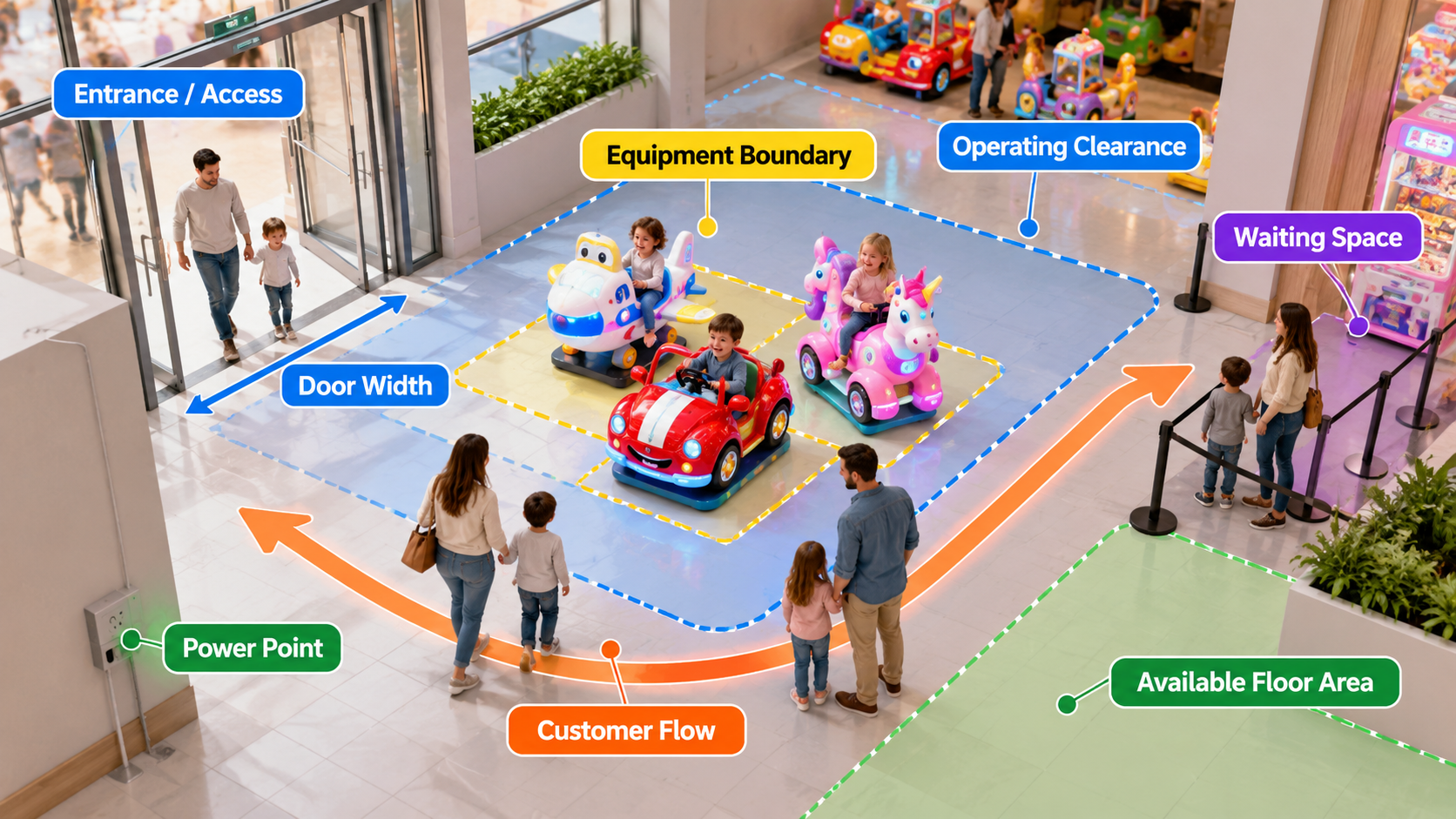
The first step is to divide the required area into three different parts.
Equipment Footprint
The equipment footprint is the physical floor area occupied by the ride itself.
This information should come from the actual model being considered. Do not estimate the footprint from photos or assume that two similar-looking rides have the same dimensions.
Before ordering, browse the full product range and record the dimensions of each shortlisted ride.
Operating Clearance
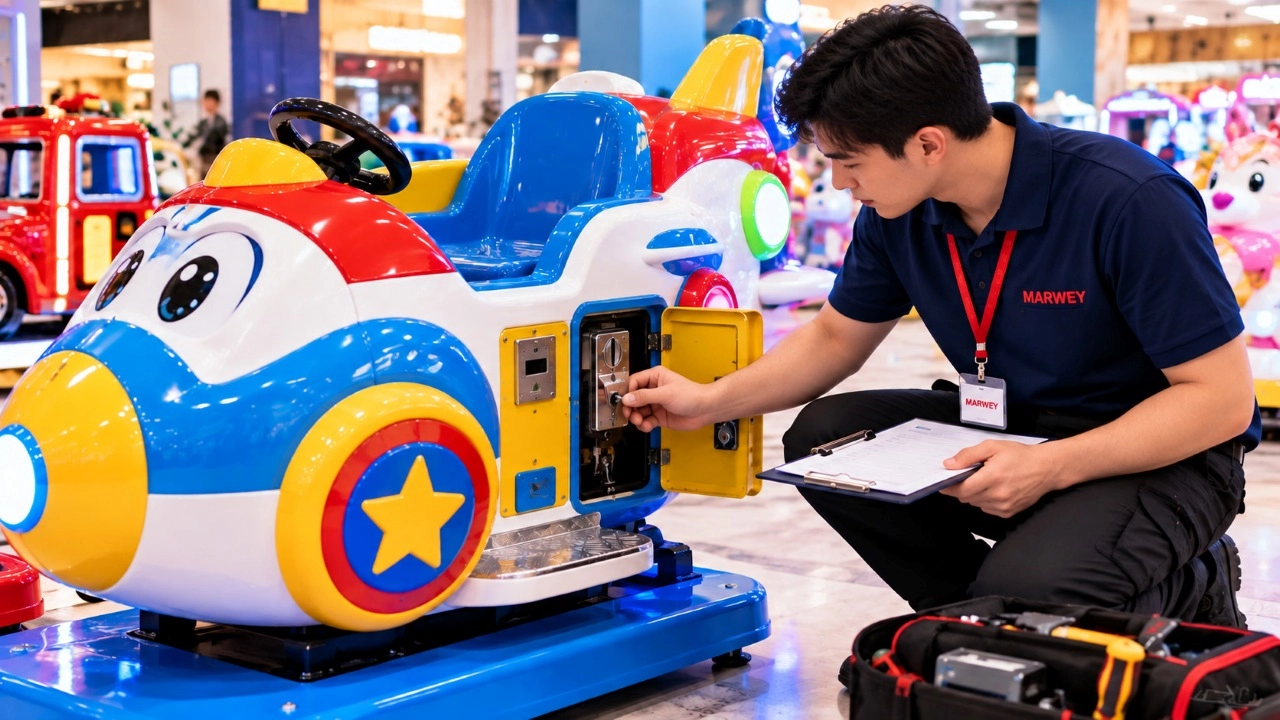
Operating clearance is the additional space needed around the equipment for normal use, access and maintenance.
The required clearance can vary according to the machine, placement and local venue conditions, so it should be checked for the specific project.
Customer Waiting and Circulation Space
A commercial layout also needs enough room for customers to approach the attraction, wait when necessary and move away without blocking surrounding traffic.
This is especially important in shopping malls, FECs and indoor playgrounds where the ride area may share circulation with other attractions or retail activities.
2. Plan the Area According to Project Scale
Different project sizes require different planning approaches.
The following size ranges are planning examples only. They are not universal installation or safety standards.
Small Kids Corner — 3–5㎡ Planning Example
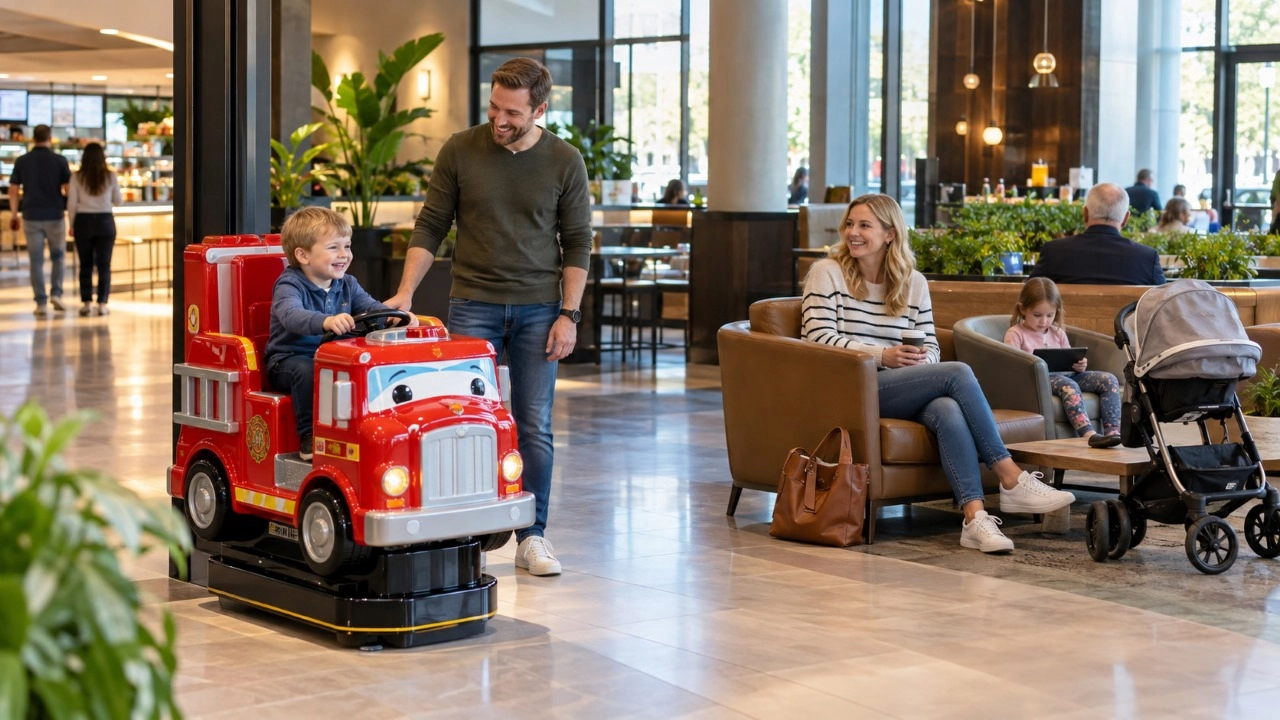
A small kids corner may be considered for a venue that wants to introduce one or a limited number of compact rides.
This type of area may be suitable for:
- Small shopping mall corners
- Restaurant waiting areas
- Hotel family areas
- Supermarket entertainment corners
- Compact commercial spaces
Compact coin operated kiddie rides are commonly considered for small commercial corners.
The main planning priority is to avoid using the entire available area for equipment. Space still needs to be considered for access and customer movement.
Medium Kids Area — 10–20㎡ Planning Example
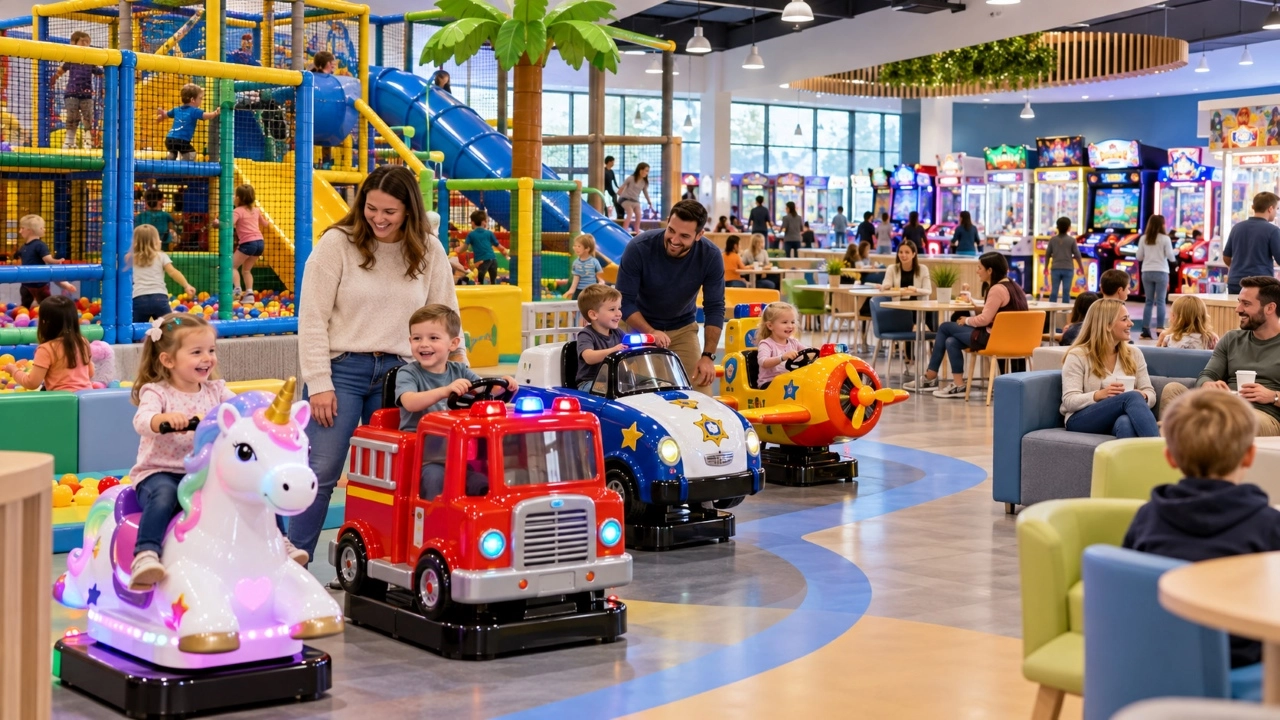
A medium-sized area can provide more flexibility for combining several compact rides or creating a more visible children's entertainment zone.
At this scale, buyers should think about:
- Equipment combination
- Entrance and exit points
- Customer circulation
- Visibility from nearby traffic
- Power access
- Maintenance access
- Waiting space
Rather than filling every available square meter with machines, the layout should allow the area to function comfortably during busy periods.
Larger Attraction Area — 30㎡+ Planning Example
A larger area may support a broader mix of equipment or more substantial attractions.
At this stage, the project should be planned more like a complete entertainment area rather than a collection of individual machines.
Kiddie train rides can be evaluated when the venue has enough room for a defined route or attraction area.
Larger projects may also require more detailed planning for customer circulation, installation access and the relationship between different attractions.
3. Measure the Site Before Selecting Equipment
A floor plan should be based on actual site measurements.
Before requesting a final layout, record the main physical conditions of the venue.
Length and Width
Measure the usable floor area rather than the total room size.
Columns, fixed furniture, walls, counters or other obstructions can reduce the space available for equipment.
Ceiling Height
Some equipment may require additional vertical space.
Even for lower machines, ceiling features, lighting, signage or building systems should be considered.
Door and Access Width
Measure the route the equipment must travel from the delivery point to the final installation area.
A machine that fits into the final space may still be difficult to install if it cannot pass through a doorway or corridor.
Power Location
Record where suitable power points are located.
Power preparation should be based on the confirmed requirements of the selected equipment.
Floor Condition
Check whether the installation area is level and suitable for the equipment being considered.
Fire and Emergency Access
The entertainment area should not interfere with required emergency routes or other venue access requirements.
These conditions should be confirmed according to the local venue and applicable requirements.
Visibility
A ride area that is difficult to see may perform differently from one positioned along a natural customer route.
Visibility should therefore be considered together with space efficiency.
4. Why Equipment Footprint Alone Is Not Enough
One of the most common planning mistakes is to calculate the number of rides using only machine dimensions.
For example, if several machine footprints mathematically fit within a given floor area, that does not automatically mean the layout is practical.
The project may still need space for:
- Customer access
- Waiting
- Parent supervision
- Maintenance
- Cleaning
- Equipment doors or service panels
- Power connections
- Movement between machines
- Surrounding venue traffic
This is why the final layout should be reviewed as a complete operating area rather than a simple equipment packing exercise.
5. Use Space Ranges as Planning Examples
The table below can help buyers understand the general difference between project scales.
All areas below are planning examples only. Final layouts must be checked against actual equipment dimensions and venue requirements.
| Planning Example | Typical Planning Approach | Key Considerations |
|---|---|---|
| 3–5㎡ | Small kids corner with compact equipment | Equipment footprint, customer access, power, visibility |
| 10–20㎡ | Medium kids area with multiple rides | Equipment mix, circulation, waiting space, maintenance access |
| 30㎡+ | Larger attraction area or broader equipment mix | Customer flow, installation access, attraction zoning, operational planning |
These examples can help with early-stage planning, but they should not be treated as fixed capacity rules.
Two venues with the same floor area may require different layouts because of columns, entrances, customer traffic, equipment dimensions or other site conditions.
If your floor plan is ready, ask for a custom kiddie ride layout.
6. Plan Customer Flow Before Finalizing the Layout
A practical layout should guide customers naturally through the entertainment area.
Avoid creating narrow points where parents, children and other visitors are forced into the same small passage.
In a shopping mall or FEC, consider how the ride area connects with:
- Main pedestrian routes
- Entrances
- Food and beverage areas
- Other attractions
- Seating areas
- Payment points
- Retail zones
The goal is not simply to fit more machines into the space. The area should also be easy to understand and comfortable to use.
7. Leave Room for Future Changes
Commercial venues often change after opening.
An operator may later want to replace a machine, add another ride or adjust the layout based on customer traffic.
Leaving some flexibility in the original plan can make these changes easier.
For a new project, it may be more practical to start with a manageable layout and review actual operation before filling every available area.
FAQ
How many rides fit in 10 square meters?
There is no universal number.
The answer depends on the dimensions of the selected rides, required clearance, customer circulation, access and the shape of the venue.
A 10㎡ area can be used as a planning example for a small-to-medium kids zone, but the exact number of machines should only be determined after reviewing the actual product dimensions and floor plan.
Can a ride be installed near a checkout area?
It may be possible, but the decision should be based on the actual site.
The ride should not interfere with checkout queues, customer movement, access or other venue requirements.
Before installation, review the equipment footprint, operating space, power location and customer flow around the checkout area.
Build the Layout Around the Actual Venue
The most effective kiddie ride layout is not necessarily the one with the largest number of machines.
A practical commercial plan balances equipment footprint, customer access, circulation, power, maintenance and visibility.
Use 3–5㎡, 10–20㎡ and 30㎡+ only as early planning examples, then confirm the final arrangement using the actual equipment specifications and site measurements.
What Safety and Quality Documents Should You Request for Commercial Kiddie Rides?
Kiddie Ride Maintenance Checklist for Daily Commercial Operation
How to Plan a Kiddie Ride Area for a Supermarket, Hotel or Family Restaurant
Best Kiddie Rides for Indoor Playgrounds and Family Entertainment Centers
FAQ
How do you ensure the quality of kiddie rides?
We implement strict quality control during production and testing. Each kiddie ride is tested before delivery to ensure safety, durability, and stable performance.
What is the price of kiddie rides?
The price of kiddie rides depends on the model, size, and customization requirements. Our coin operated kiddie rides are competitively priced for global markets. Contact us to get the latest price list and quotation.
What certifications do your kiddie rides have?
All our kiddie rides are manufactured under strict quality control and comply with international standards such as CE certification.
How profitable are kiddie rides for business? 🔥
Kiddie rides are a highly profitable investment for shopping malls and amusement centers. With low maintenance costs and high demand, many clients can achieve a fast return on investment.
Do you support OEM & ODM for custom kiddie rides? 🔥
Yes, we are a professional OEM & ODM kiddie rides manufacturer. We support custom design, branding, colors, and themes to help you stand out in your market.
Kids Electric Swing Ride Commercial Amusement Game Machine
These durable electric swing rides are ideal for amusement parks and family entertainment centers. Safe, simple to operate and long-lasting, they are great commercial amusement equipment for sale.
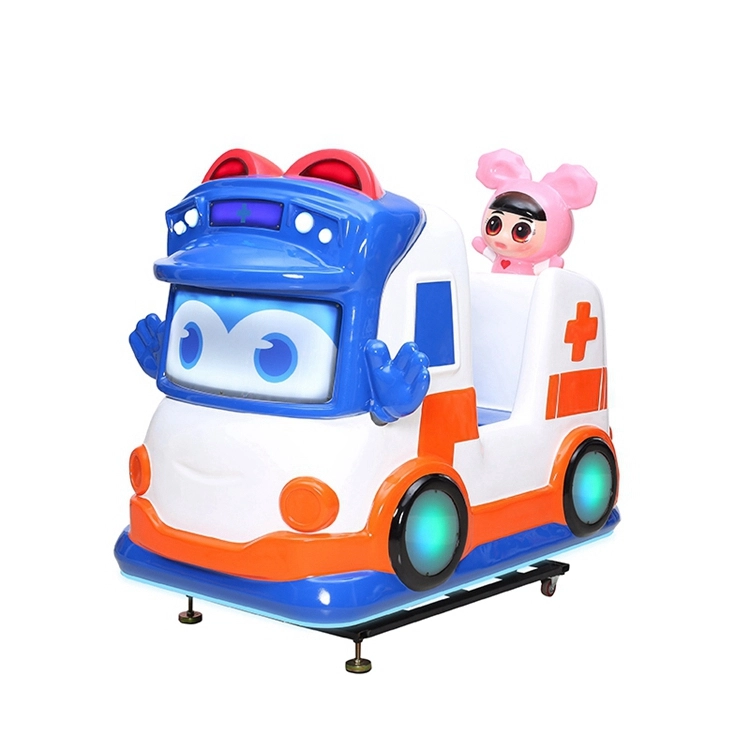
Indoor Supermarket Coin Operated Kids Amusement Ride Machine
These durable coin-operated indoor amusement machines fit supermarkets and family venues perfectly. They integrate video content and fun movements to delight kids and effectively draw more visitors.
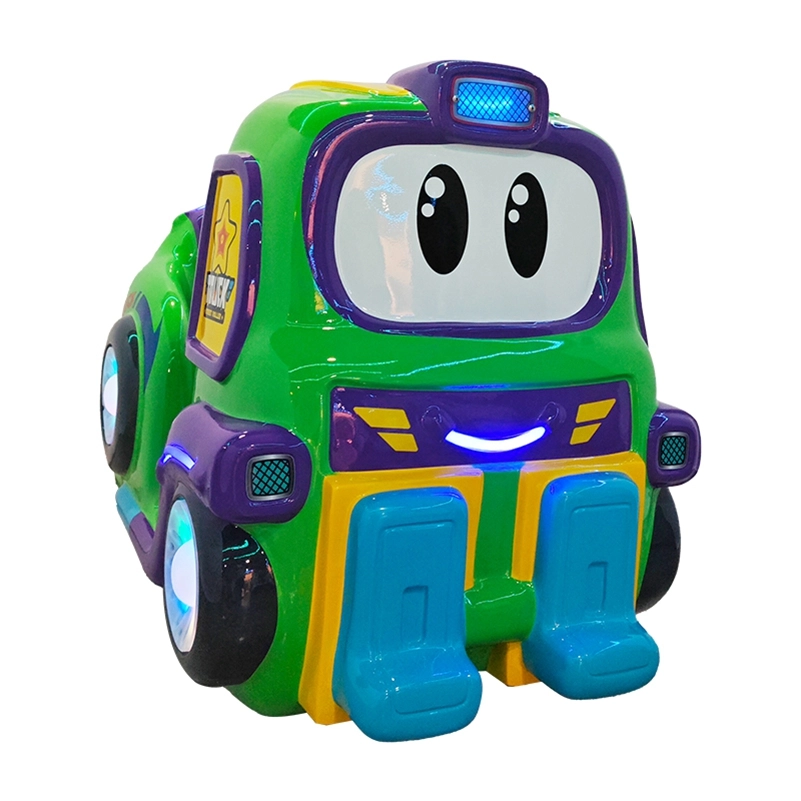
Children Coin Operated Swing Car Engineering Team MP5 Arcade Equipment
This coin-operated electric MP5 swing car is suitable for amusement parks and kids' play areas. Well-crafted and easy to use, it provides safe and enjoyable rides for young children.
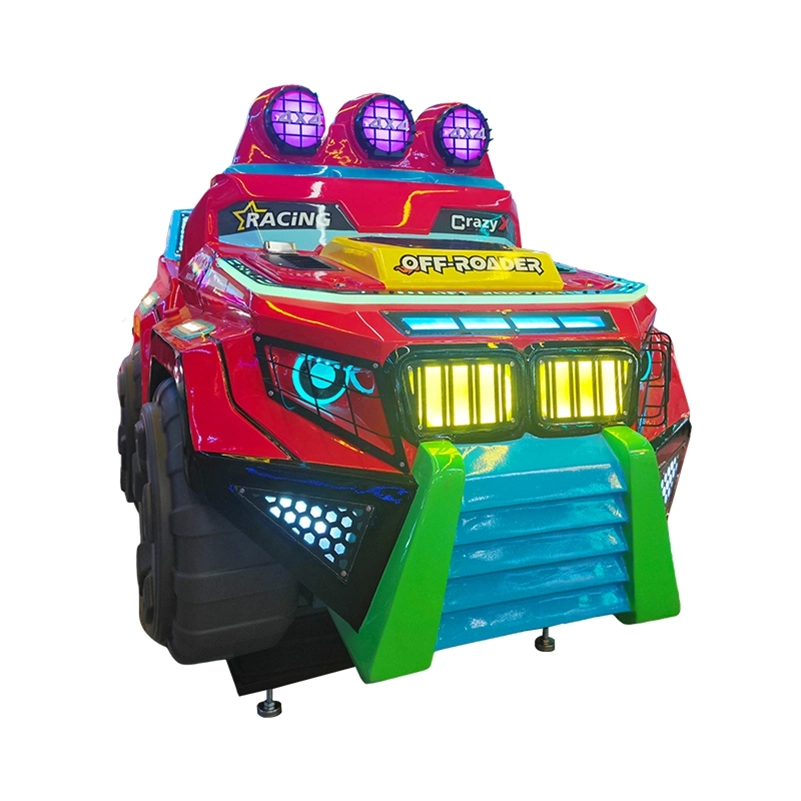
New Design Coin Operated Swing Machine Indoor Commercial Kiddie Ride
This newly designed coin-operated kiddie swing machine is built for indoor commercial use. It is easy to install and runs reliably, providing safe and entertaining fun for children in arcades and amusement parks.
Leave a message
Contact us

info@marwey.com

+86 189 2218 4260

101, Bldg. A, No. 501, Shixin Road, Dalong Street, Guangzhou, Guangdong, China
Quick Links
Kiddie Ride
Marwey Amusement
marwey_arcade
Marwey
Arcade Marwey
Whatsapp: +8618922184260